
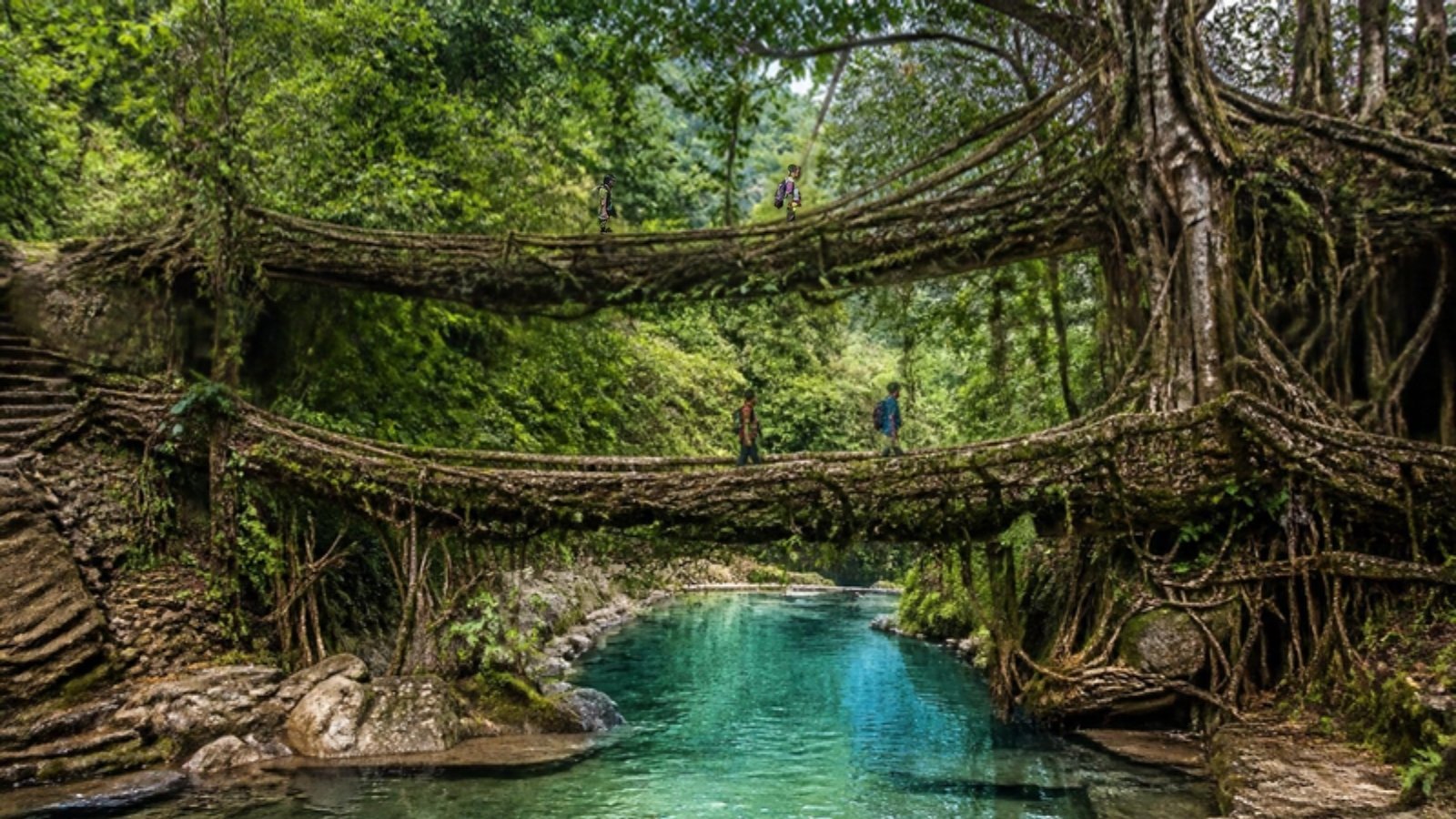
Quick answer: Meghalaya's most famous living root bridge is the double decker at Nongriat, reached by about 3,500 stone steps from Tyrna near Sohra (Cherrapunji). Visit from October to May for dry steps; October and November are ideal. Mawlynnong and the Riwai bridge make an easy add-on.
Short answer: The best-known living root bridge in Meghalaya is the double decker bridge at Nongriat, reached by a descent of about 3,000 to 3,500 stone steps (roughly 3 km) from Tyrna village near Sohra (Cherrapunji), about 54 km from Shillong. The best season is October to May, with October and November ideal for full streams, clear skies and drier steps. Mawlynnong village and the nearby Riwai root bridge are a gentler add-on, about 78 to 90 km from Shillong.
Quick facts
| Item | Details |
|---|---|
| Best months | October to May; October and November are ideal. June to September is monsoon |
| Climate | Mild; Shillong and Sohra about 1,500 m. Sohra is one of the wettest places on earth |
| Nongriat trek | About 3 km and 3,000 to 3,500 steps each way from Tyrna; 2 to 3 hours down, 3 to 4 hours up |
| Duration | 5 to 6 days in Meghalaya, ex Guwahati, to cover Shillong, Sohra, Nongriat and Mawlynnong |
| Difficulty | Moderate; the return climb is the hard part |
| Nearest airport | Guwahati (Lokpriya Gopinath Bordoloi International), about 3 hours by road to Shillong; Shillong (Umroi) has limited flights |
| Nearest rail | Guwahati |
| Permits | No permit for Indians or foreigners; small village entry, guide and parking fees apply |
| Typical budget | Rs 18,000 to Rs 35,000 per person for a 5 to 6 day trip ex Guwahati (indicative) |
What are the living root bridges of Meghalaya?
Living root bridges, called jingkieng jri in Khasi, are footbridges grown by guiding the aerial roots of the rubber fig tree (Ficus elastica) across streams. Khasi and Jaintia communities train the roots over years using bamboo or betel nut frames until they thicken and interlock. A mature bridge can carry dozens of people and grows stronger with age.
The bridges are found mainly in the southern slopes of the Khasi and Jaintia hills, where heavy rainfall makes ordinary wooden bridges rot quickly. In 2022 the Jingkieng Jri living root bridge cultural landscapes were added to India’s tentative list for UNESCO World Heritage status.
How do you reach the Nongriat double decker root bridge?
Drive from Shillong to Sohra (about 54 km, roughly 2 hours), then continue to Tyrna village, about 12 to 15 km further. From Tyrna, a stone staircase of about 3,000 to 3,500 steps descends roughly 3 km through forest and areca plantations to Nongriat. On the way you cross single root bridges and two steel suspension bridges over clear blue streams.
The double decker bridge, known locally as Umshiang, is at Nongriat village. You can continue about 1 to 1.5 hours beyond it to Rainbow Falls. Expect 2 to 3 hours to descend and 3 to 4 hours to climb back up. Registered local guides are available at Tyrna and are strongly recommended for groups.
Should you stay overnight in Nongriat?
Yes, if you can. Nongriat has simple homestays and guesthouses. Staying overnight lets you see the double decker bridge early in the morning before day visitors arrive, walk to Rainbow Falls without rushing and split the tough climb back into a separate day.
What is Mawlynnong and the Riwai root bridge?
Mawlynnong is a Khasi village in East Khasi Hills near the Bangladesh border, about 78 to 90 km (around 2.5 hours) from Shillong. It is widely described as one of the cleanest villages in Asia, with community rules on waste, bamboo dustbins and flower-lined paths.
The Riwai living root bridge is a short walk of a few minutes from the road near Mawlynnong, which makes it the easiest root bridge to see for children, elderly travellers or anyone who cannot manage the Nongriat steps. Mawlynnong is often combined with Dawki and the clear Umngot river, about 95 km from Shillong.
What is the best season to visit the root bridges?
October to May is the best period overall. October and November are ideal because streams are still full after the rains, skies are clear and steps are drier. December to February is cool and dry, with lower water levels. March to May is warm and good for swimming in the natural pools, though pre-monsoon showers begin.
The monsoon, from June to September, turns the region dramatically green and waterfalls are at their most powerful, but Sohra and nearby Mawsynram are among the wettest places on earth. Steps are slippery, streams can swell quickly and road travel is slower. Go in the monsoon only with an experienced guide and flexible plans.
How fit do you need to be for Nongriat?
The descent is easy on the lungs but hard on the knees. The climb back up is the real effort: thousands of steps in humid conditions. Anyone who can climb 15 to 20 floors of stairs at a steady pace with short breaks should manage. Trekking poles help on the way down.
Practical tips
- Start the Nongriat descent by 8 am so you have daylight for the climb back.
- Wear shoes with good grip; the stone steps can be slippery even outside the monsoon.
- Carry cash for village entry fees, guides and homestays; card and UPI acceptance is unreliable.
- Swim only where locals and your guide say it is safe; pools near the bridges can be deep and cold.
- Do not pull, cut or carve the roots, and stay on marked paths to protect the bridges.
- Respect Sunday as a church day in many Khasi villages; some services may be limited.
Carabiner Diaries runs Meghalaya trips that include the Nongriat double decker bridge, Mawlynnong and Dawki for families, school groups and small teams. To plan your route and pace, send us an enquiry at carabinerdiaries.com.
Frequently asked questions
How many steps are there to the Nongriat double decker bridge?
There are about 3,000 to 3,500 stone steps from Tyrna village to Nongriat, covering roughly 3 km. Counts vary between sources, but the climb back is the hardest part.
What is the best month to visit the living root bridges?
October and November are ideal for full streams, clear weather and drier steps. The whole period from October to May is good; the June to September monsoon is very wet and slippery.
Which is the easiest living root bridge to visit?
The Riwai living root bridge near Mawlynnong is a short walk from the road and suits children and elderly travellers. Several smaller bridges around Sohra are also easy to reach.
How far is Mawlynnong from Shillong?
Mawlynnong is roughly 78 to 90 km from Shillong, about 2.5 hours by road. It is often combined with Dawki and the Umngot river on the same day.
Is a permit needed for Meghalaya?
No special permit is required for Indian or foreign tourists to visit Meghalaya’s tourist areas. Villages charge small entry, guide or parking fees, and travellers should carry photo ID.
Can you visit Nongriat as a day trip?
Yes. A fit traveller can descend from Tyrna, see the double decker bridge and climb back in 5 to 7 hours. An overnight stay is more relaxed and lets you visit Rainbow Falls.