
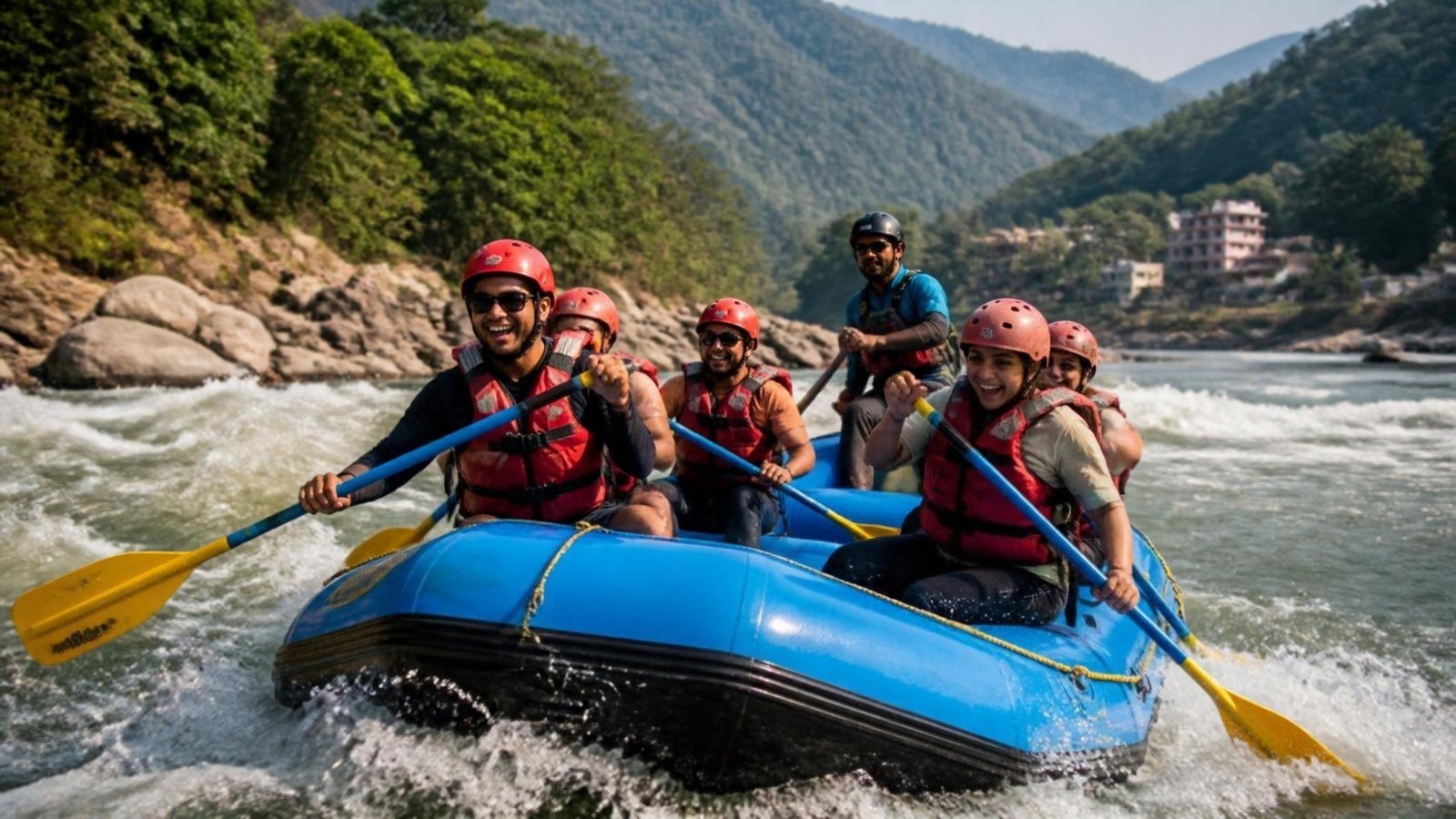
Quick answer: Rishikesh rafting runs from about mid-September to June on four main Ganga stretches: Brahmapuri (9 km, Grade I-II), Shivpuri (16 km, Grade II-III), Marine Drive (24-26 km, Grade III-IV) and Kaudiyala (35-36 km, Grade III-IV+). It stops in July and August.
Short answer: River rafting in Rishikesh runs on the Ganga from about mid-September to June and is suspended in the July and August monsoon. There are four main stretches ending near Rishikesh: Brahmapuri (about 9 to 10 km, Grade I to II), Shivpuri (about 16 km, Grade II to III, the most popular), Marine Drive (about 24 to 26 km, Grade III to IV) and Kaudiyala (about 35 to 36 km, the toughest). Most operators set a minimum age of 14 for the main stretches, and prices start around Rs 500 to Rs 2,000 per person depending on distance.
Quick facts
| Item | Details |
|---|---|
| Best months | Mid-September to June; October to April for most pleasant weather |
| Closed | July and August (monsoon high water) |
| Altitude / climate | Rishikesh about 350 m; water is cold in winter, air hot in May and June |
| Duration | 1.5 to 2 hours (Brahmapuri) to a full day (Kaudiyala) |
| Difficulty | Grade I to II for beginners up to Grade III to IV and above for experienced rafters |
| Nearest airport | Jolly Grant Airport, Dehradun, about 20 to 25 km away |
| Nearest rail | Yog Nagari Rishikesh; Haridwar Junction about 25 km away |
| Permits | None for participants; operators must be licensed. A small forest toll is collected en route |
| Typical budget | About Rs 500 to Rs 2,000 per person for Brahmapuri or Shivpuri; more for longer stretches (indicative) |
Which rafting stretch in Rishikesh should you choose?
All commercial stretches start upstream along the Badrinath road and finish near Rishikesh, commonly at NIM beach or nearby beaches. Distances and grades vary slightly between operators.
| Stretch | Distance | Rapid grade | Best for |
|---|---|---|---|
| Brahmapuri to Rishikesh | About 9 to 10 km | Grade I to II | First-timers, families, younger teens |
| Shivpuri to Rishikesh | About 16 km | Grade II to III | Most visitors, school and college groups, teams |
| Marine Drive to Rishikesh | About 24 to 26 km | Grade III to IV | Fit rafters wanting more and bigger rapids |
| Kaudiyala to Rishikesh | About 35 to 36 km | Grade III to IV, some sections rated higher | Experienced rafters, full-day trip |
Shivpuri is the standard choice. It includes well-known rapids such as Roller Coaster and Golf Course, a calm stretch for body surfing and optional cliff jumping, and takes about 2.5 to 3 hours on the water.
What do rapid grades mean?
River rapids are graded on an international scale from I to VI. Grade I is moving water with small waves. Grade II has clear channels and small rapids. Grade III has larger, irregular waves that need precise manoeuvring. Grade IV has powerful, turbulent rapids where falling out is more serious. Grades V and VI are expert and extreme and are not run commercially for tourists. The grade of a rapid on the Ganga can change with water level, so the same stretch feels different in October and in May.
When is the rafting season in Rishikesh?
Commercial rafting runs from about mid-September to the end of June. It stops in July and August, when monsoon rains raise the water level and current to unsafe levels.
- October to November: Water is still high after the monsoon, so rapids are strong and the weather is pleasant.
- December to February: Water is clear and cold, rapids are slightly milder and wetsuits help on longer stretches.
- March to June: Peak season with warm weather; snowmelt raises the water from May. Weekends are crowded.
Is rafting in Rishikesh safe?
Rafting with a licensed operator and certified guides on the appropriate stretch is generally safe, but it is an adventure sport with real risk. Accidents usually involve unlicensed operators, ignoring guide instructions, alcohol or rafting when the river is high.
What safety standards should you check?
- The operator holds a valid licence from the Uttarakhand tourism or adventure sports authority.
- Every rafter gets a properly fitted life jacket and helmet, and paddles are in good condition.
- Guides are trained in white water rescue and first aid, and give a safety briefing before launch.
- A safety kayaker or a second raft accompanies groups on harder stretches.
- Rafts are not overloaded, typically 6 to 8 rafters plus a guide.
Who should not raft?
People with serious heart conditions, uncontrolled blood pressure, recent surgery, epilepsy or pregnancy should not raft. Inform your guide of any medical condition. Swimming is not mandatory, but non-swimmers should choose easier stretches.
What is the minimum age for rafting in Rishikesh?
Most operators set 14 years as the minimum for Brahmapuri and Shivpuri and 16 to 18 years for Marine Drive and Kaudiyala. Some allow children of about 12 years on the Brahmapuri stretch in calm conditions. Upper age limits of around 60 are common. Check the rule with your operator before booking.
Practical tips
- Wear quick-dry clothes and secure sandals or water shoes; avoid cotton and flip-flops.
- Leave phones and valuables in the vehicle or carry a waterproof pouch; most operators offer GoPro footage for a fee.
- Book with a licensed operator and avoid roadside touts offering very low prices.
- Raft in the morning on weekends to avoid crowded rapids.
- Apply waterproof sunscreen; the reflection off the water burns quickly.
- Never raft after drinking alcohol; it is banned and dangerous.
- Carry a small amount of cash for the forest toll and snacks at Shivpuri.
Carabiner Diaries runs Rishikesh rafting and camping trips for school groups, colleges and corporate teams, using licensed rafting partners. To plan a safe trip for your group, send us an enquiry at carabinerdiaries.com.
Frequently asked questions
When is rafting closed in Rishikesh?
Commercial rafting is usually closed in July and August because monsoon rains make the Ganga too high and fast. The season runs from about mid-September to June.
Which is the best rafting stretch in Rishikesh for beginners?
Brahmapuri to Rishikesh (about 9 km, Grade I to II) is the gentlest. Shivpuri to Rishikesh (about 16 km, Grade II to III) is the most popular and suits most first-timers who want real rapids.
Do I need to know swimming to raft in Rishikesh?
No. Swimming is not mandatory because every rafter wears a life jacket and follows the guide’s instructions. Non-swimmers should choose Brahmapuri or Shivpuri.
What is the minimum age for rafting in Rishikesh?
Most operators require rafters to be at least 14 years old for the main stretches, and 16 to 18 for Marine Drive and Kaudiyala. A few allow 12-year-olds on Brahmapuri.
How much does rafting in Rishikesh cost?
Shorter stretches such as Brahmapuri and Shivpuri typically cost about Rs 500 to Rs 2,000 per person. Marine Drive and Kaudiyala cost more. Prices vary by operator, season and group size.
How long is the Shivpuri rafting trip?
The Shivpuri stretch is about 16 km and takes roughly 2.5 to 3 hours on the water, plus transfer time from Rishikesh to the starting point.